oiklaltd · Apr 14, 2023 · Updated Apr 15, 2023 · 10 min read
Enhancing Audio Experiences through Equal Loudness Curve Correction, Powered by Smartphone
Understanding how equal loudness impacts listening, and why Perception can change the way audio feels in real rooms, headphones, games, films, and everyday playback.
Equal Loudness and the Human Ear
Understanding how a listener perceives sound is central to a memorable audio experience, whether you are writing, producing, engineering, designing a room, or listening at home. Equal loudness contours describe one of the most important reasons measured sound and perceived sound can feel different.
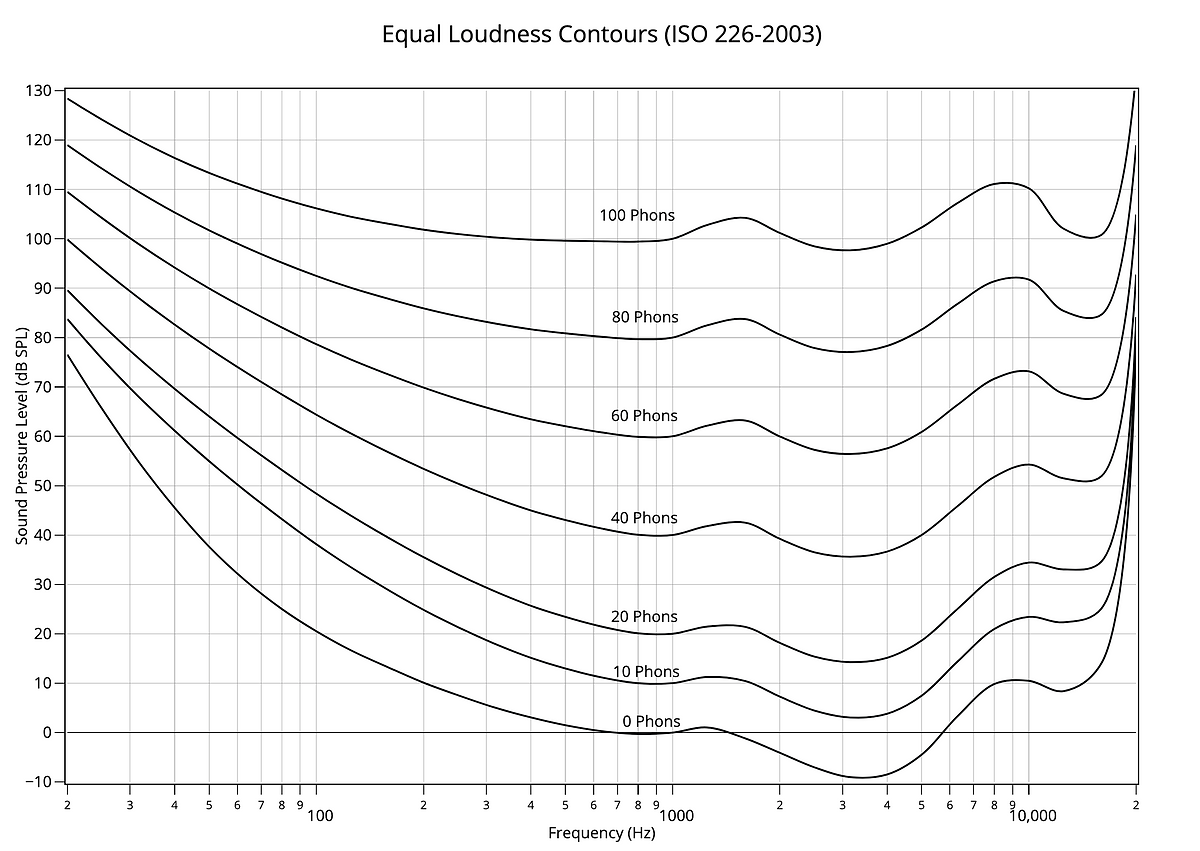
Human hearing is nonlinear. The auditory system is most sensitive in the midrange, especially around the speech band between roughly 1 kHz and 5 kHz. At lower sound pressure levels, bass and extreme treble can feel comparatively quieter than the midrange. As the level rises, sensitivity to those low and high bands rises too, so the balance of the same audio event changes in the listener's mind.
Equal loudness curves map this relationship between frequency and perceived loudness. Loudness is often discussed in phons: at 1 kHz, one phon corresponds to one decibel of sound pressure level. The useful idea is simple: two tones can measure very differently yet be perceived as equally loud, depending on frequency and level.
Why Level Changes the Experience
A balanced and natural-sounding playback can change dramatically across listening volumes. A mix that feels full at one level may feel thin when played quietly, while a sound design element that feels wide and physical at one level may lose impact when the low and high information rolls away perceptually.
This matters in music, film, games, headphone design, speaker design, room testing, codecs, and accessibility. Understanding what information is necessary to recreate an audio event is part of why modern audio can be streamed, mastered, compressed, reproduced, and spatialized convincingly.
It also matters for hearing protection. If the only way to recover bass, air, and impact is to turn the level up, listeners are pushed toward fatigue and risk. Equal-loudness correction offers another path: keep the actual level sensible while restoring the spectral balance the ear expects.
Spatialization
Equal loudness is not only tonal. It also influences spatialization: the perception of where sound sits in width, depth, and distance. Our auditory system uses interaural time differences and interaural level differences to locate sound. Frequency balance affects those cues.
At low sound pressure levels, less-sensitive low and high bands can reduce the clues that make an explosion, a bass hit, a room reflection, or a cinematic object feel placed in space. As level rises and those bands become more present, localization and immersion can improve.
For sound designers and mix engineers, that relationship is a practical design constraint. If level, equal-loudness curves, and spatial cues are linked, then a playback system should consider all three instead of treating loudness correction as a static EQ preset.
History and Measurement
The equal-loudness story began with work by Harvey Fletcher and Wilden A. Munson at Bell Telephone Laboratory in the 1930s. Their research produced the Fletcher-Munson curves, an early map of equal-loudness contours, and fed into telephone microphone and hearing-aid development.
The International Organization for Standardization later refined the field with ISO 226:2003, one of the standard references for equal-loudness contours. The measurement process is conceptually similar to an optician's chart: listeners compare sine waves at different frequencies and adjust levels until tones are perceived as equally loud.
Individual hearing varies, so these curves are not a personal audiogram. They are an average map of a human tendency. Perception builds from that tendency, then uses device and listening context to make the correction more useful in real rooms and everyday playback.
Applications Beyond Music
Equal-loudness curves show up in places that seem far apart: mastering, game audio, headphone tuning, aircraft noise regulation, room design, and industrial testing. In aviation, for example, understanding how high and low frequencies propagate and are perceived can influence whether a design meets legal noise limits.
Anechoic spaces remove reflections so engineers can understand an audio event without the room coloring it. At the other end of the scale, in-ear monitors and headphones must deal with the shape of the individual ear, the driver response, and the perception of level all at once.
The common thread is that listening is never only a number on a meter. It is the interaction between sound pressure, frequency, space, equipment, and the human auditory system.
Introducing Perception
Perception is OIKLA's answer to the challenges posed by equal-loudness contours. The product direction is to use smartphone-aware listening context, microphone input, and real-time processing to estimate how the listener is experiencing audio in their actual environment.
Rather than asking users to keep turning playback louder, Perception can apply equal-loudness contour correction so the experience feels louder, wider, and deeper than the raw room level would suggest. The goal is not hype. The goal is a more stable perceived balance at safer levels.
How Perception Works
- Connect to the smartphone microphone or browser audio context and estimate the real listening level.
- Filter the captured signal through an inverted equal-loudness curve to estimate the incoming loudness.
- Use ISO 226:2003 equal-loudness data to derive the relevant phon curve.
- Let the listener choose a target listening level with a simple control.
- Compare the measured curve and target curve to calculate the correction needed.
- Apply the resulting gain with frequency-specific processing that can reach beyond a conventional static EQ.
- Process left and right channels independently so stereo image and localization cues stay intact.
- Update the correction in real time so the perceived experience tracks the actual listening situation.
Benefits of Equal-Loudness Correction
Hearing protection
Perception is designed to make safer listening feel complete, reducing the temptation to chase impact by raising volume.
Reduced listening fatigue
A fuller perceived balance at lower levels can help listeners stay engaged without extended high-volume exposure.
Audio clarity and lower distortion
Many speakers and rooms behave better at sensible levels. Equal-loudness correction helps preserve detail without forcing playback into harsher ranges.
Improved localization and immersion
Restoring low and high information at lower levels can make depth, distance, and spatial cues easier to perceive.
Speech intelligibility
Level-aware correction can support vocal clarity for conversations, podcasts, film, and broadcast content.
Headphone and speaker performance
Accounting for the ear's nonlinear response helps playback systems feel more accurate across a wider range of listening levels.
Personalization
A listener's preferred level and hearing context matter. Perception is built around adapting the experience to the person and room.
Accessibility
A louder perception at safer levels can make audio more enjoyable for listeners with different sensitivities and environments.
Conclusion
Perception offers a practical way to bring equal-loudness correction into real-world listening. By addressing bass, treble, spatial cues, listening fatigue, and safe playback together, OIKLA can make audio feel full and immersive without relying on higher volume as the only path to excitement.
OIKLA is continuing to refine this technology across the hosted browser app, SHAPE, and related webapp surfaces. Your ears are part of that work: sign in, test the tools, and help shape how the world listens.